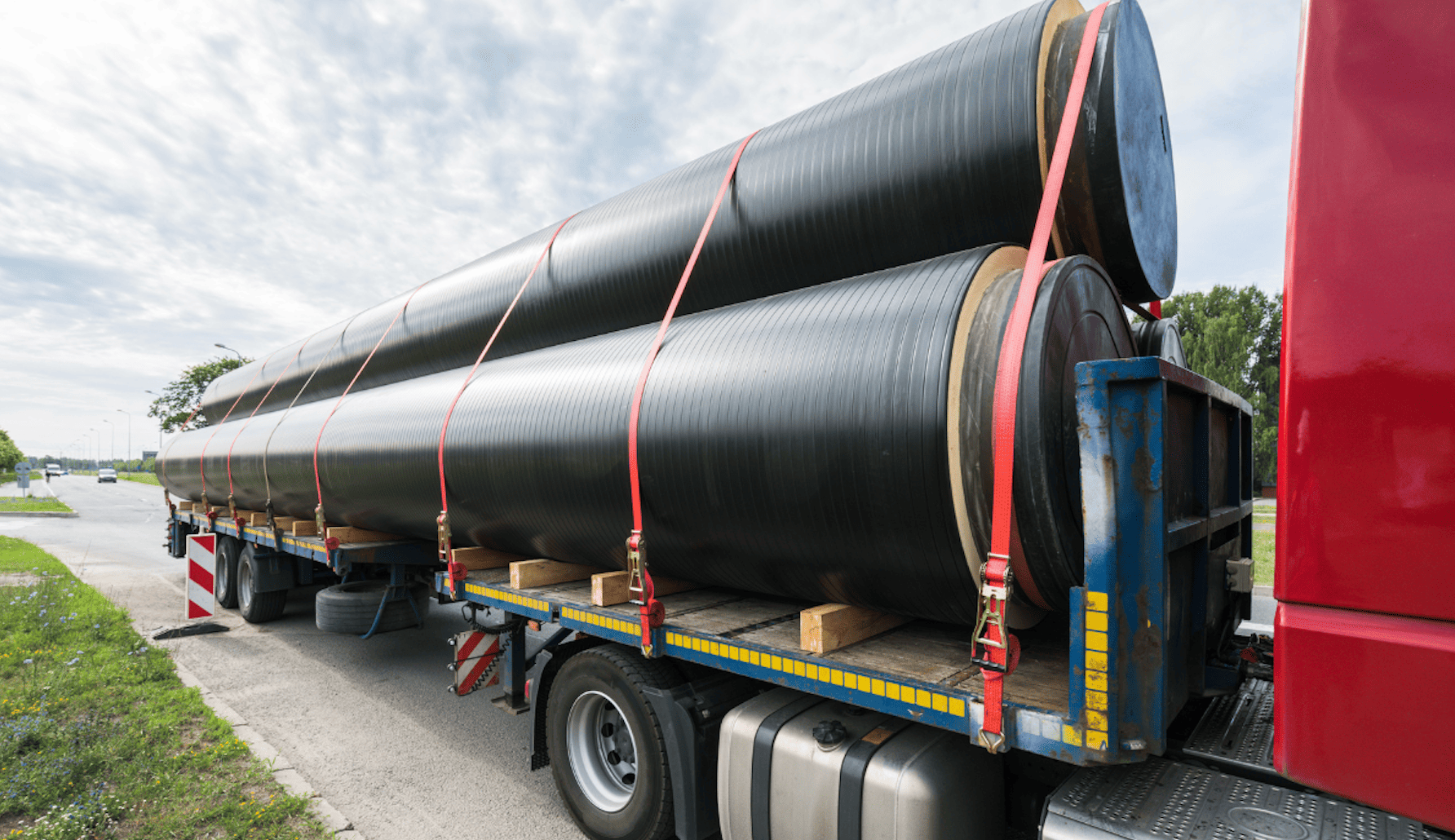
Pipe deliveries aligned with the construction schedule
Save Pro Solutions arranges large diameter pipe transport from the manufacturer or storage facility to construction sites, industrial plants and installation locations. We handle domestic routes in Ukraine as well as import and export shipments. Vehicle selection and dispatch arrangements are agreed against the consignment specification, loading conditions and the recipient’s capacity to receive the goods.
Delivery order matters on a pipeline project. When pipes of different lengths, diameters or applications need to reach separate work areas, we take this into account when planning the loads. Dispatching against site readiness helps avoid unnecessary repositioning and repeated handling. For consignments requiring several vehicles, we agree the arrival sequence, receiving contacts and the operating windows for handling equipment.
Pipe specifications and the number of vehicle loads
Planning starts with an itemised list, rather than the total shipment weight alone. For each line item, we need the actual outside diameter, length and weight of each pipe, the quantity and the material. A DN designation should be supplemented with transport dimensions. Any sockets, flanges, insulation or transport frames must also be included when establishing the loading envelope.
Steel pipes with different wall thicknesses may have the same diameter but different weights and support requirements. For polymer, glass-reinforced plastic and reinforced-concrete products, the manufacturer’s instructions on transport, permissible contact and lifting must be checked separately. Acceptance of a particular consignment is confirmed after reviewing its characteristics.
The number of pipes per vehicle depends on the agreed loading arrangement, overall loaded dimensions and weight distribution. A light but bulky shipment may use up the available space before reaching the payload limit. For heavy products, axle loading may become the limiting factor. Stacking or nesting pipes inside one another is considered only where the manufacturer permits it and suitable restraint and subsequent unloading can be arranged.
Flatbed or low-loader for the pipe consignment
An open trailer provides access for crane loading from above or from the side. We assess flatbed transport against the usable deck length, payload capacity and available anchorage points. Long sections may require an extendable trailer, configured for the actual dimensions, support positions and route. Particularly long sections also require long load transport planning, including manoeuvring at the entrance and the component’s orientation for unloading.
Where overall loaded vehicle height is critical, we assess low-loader transport. A lower deck can help keep a pipe within the available height clearance, but the usable loading length and weight distribution still need checking. The cargo description alone does not determine the trailer: a flatbed may be the more appropriate option for a particular batch.
The transport category depends on the dimensions and weight of the vehicle with its load. A large pipe diameter does not automatically make every shipment abnormal. Where the loaded configuration exceeds the applicable limits, the movement is planned as oversized cargo transport, with the required approvals. This assessment takes place before confirming the vehicle.
Protecting coatings, pipe ends and shape
For coated pipes, the surface condition after unloading matters alongside arrival at the destination. Damage to insulation, a weld bevel, flange or socket can affect readiness for installation. We therefore agree protection for coatings and pipe ends together with the loading and securing arrangements.
The plan must address the risk of pipes rolling or moving lengthways. Suitable cradles, stops, separators and protection at restraint contact points may be needed. Their design, number and positioning depend on the particular cargo. For products susceptible to deformation, permissible support loads also need to be considered. A universal lashing count or support layout cannot be specified without the pipe data.
Before dispatching the vehicle, agree who provides the supports and lifting equipment, where the products may be lifted and which restrictions the manufacturer imposes. At the receiving site, check access, working space for handling equipment and the prepared storage area. Readiness for unloading affects the schedule just as much as the availability of the pipes at the factory.
At handover, check quantities and markings and inspect accessible surfaces, pipe ends and packaging. Record visible damage or discrepancies in the documents and photographs. An agreed inspection procedure helps the consignor, carrier and recipient transfer the shipment with a clear record of its condition.
Domestic transport in Ukraine and deliveries from Europe
For a domestic route, we assess access to the actual site as well as the roads between cities. Long pipe sections make bends near the entrance, gate clearance, overhead obstructions and vehicle positioning at the unloading point especially relevant. For a large consignment, arrivals are coordinated with the receiving rate to avoid vehicles accumulating at the site.
Import and export shipments are arranged through our international road freight services. Before collection from the factory, we agree the readiness date, vehicle and driver access requirements, loading window and customs clearance location. Where dimensions exceed the applicable limits, international oversized transport arrangements apply: road permits, escort requirements and permitted movement times are checked for the countries on the route.
The invoice, packing list and transport documents should describe the product references, quantities and weights consistently. Certificates and information on material and origin are provided as required for the particular shipment. Customs brokerage is agreed separately; road permits and customs clearance serve different purposes. The planned delivery period is established after checking the route, documents and readiness of the parties involved.
Transport costs and requesting a quotation
The cost of pipe transport depends on the number and configuration of vehicles, distance and positioning to the loading point. Supports and equipment, permits, escorts where required, agreed handling operations and waiting conditions also affect the quotation. The same distance does not necessarily mean the same budget for a long-load shipment: a different loading arrangement may change the number of trips.
The quotation should define the service scope and separate charges, including crane operations if these need to be arranged. Cargo insurance is agreed on request; cover during transport, loading and unloading must be checked in the policy. It should not be assumed to be included automatically in the freight rate.
For a large diameter pipe delivery quotation, send:
- the collection and delivery addresses and preferred dispatch date;
- an itemised specification showing pipe diameters, lengths, weights and quantities;
- details of coatings, packaging, flanges and other projecting parts;
- photographs or drawings and the manufacturer’s support and lifting requirements;
- information on handling equipment at both sites and the required delivery sequence.
Save Pro Solutions will prepare a transport option for your consignment, agree the operating conditions and provide a quotation. Contact us to plan pipe deliveries within Ukraine or between Ukraine and Europe around your project schedule.